Thursday, January 19, 2012

Chinese Good Luck Charms


In America you will encounter the occasional lucky horseshoe or four-leaf clover, but in Taiwan good luck charms are truly ubiquitous. There are literally hundreds of different ones, and Chinese New Year is the time they are especially featured.

Large hanging charms of golden coins and yuan bao.

Many of the charms represent money, which in turn symbolizes prosperity in general. After all, what could be luckier than money? These money charms often take the form of actual coins, usually the old Chinese cash which were round with square holes, as seen above. Even more common than coins are yuan bao, the hat-shaped objects which were the traditional Chinese form of gold and silver ingots.

Traditionally gold or silver, yuan bao are also seen here in jade, amber, and crystal.

Jade bi, round jade discs with central holes. 

Jade bi (pronounced bee) like these were ritual objects in ancient China and pre-date coins. They are much used today, and because of their coin-like shape blend in well with other good-luck charms. Below some bi form a yuan bao, while others are printed to resemble coins.

Strings of charms with yuan bao, bi, and coins

A Chinese money god holds a yuan bao and sits on a pile of golden coins and more yuan bao.]

Many fruits and vegetables are lucky. A yellow or orange color symbolizes gold and money, while many seeds indicate abundance and prosperity. Although they never existed in ancient China, sweet corn and peanuts are now so popular that they are as familiar in lucky charms as they are to eat.

The orange above represents prosperity and abundance, as do the ears of corn below.

If the peanut symbolism isn’t clear enough, these are additionally stamped with the words for happiness and luck.


Chinese years work on a 12-year repeating cycle, with a special animal for each year: Rat, Ox, Tiger, Rabbit, Dragon, Snake, Horse, Goat or Sheep, Monkey, Rooster, Dog, and Pig. This year (Jan 23, 2012 – Feb  9, 2013) is a Dragon year, so I plan to cover dragons more thoroughly in another post. Whatever year you are born in becomes your special lucky piece. For example, if you are born in a monkey year, then you are considered a ‘monkey’, and will always want to wear or display monkey charms.

Goat Year is long over, but this lucky goat charm continues to serve.

All the zodiac animals take part in this string of ceramic charms

You likely noticed in several of the photos that the charms are tied with elaborate knots, usually with red string. These special lucky knots are a traditional Chinese craft, and some charms consist of knots all by themselves. A couple of major lucky symbols that I cannot omit are ruyi, a kind of good-luck scepter, and bats, already covered previously.  Real firecrackers, useful in scaring away evil spirits, go off constantly during Chinese New Year, and fake firecrackers of all sizes are also seen everywhere: 


These firecrackers are one foot high not including the ‘fuses’.

The Taipei 101 building, for a while the tallest building in the world. (Photo from Wikipedia)

A close-up reveals pendant ruyi hanging above giant lucky coins, presumably symbolizing how much money you’ll need to shop in the boutiques inside

These examples barely scratch the surface of Chinese good luck symbols. Let me know if you have a favorite good-luck charm of your own, either traditional or something that is your personal talisman. Here’s wishing all of you good luck and prosperity for the coming Dragon Year.


The outer charms feature fish; the middle one with Guan Yin is especially made for use in cars, saying “Safety in Traffic” and “Leave happily, Return safely”.]

Monday, January 2, 2012

The Remarkable Paintings of Johan Zoffany: Interiors


The paintings of Johan Zoffany, 1733-1810, are always eye-catching. Visually stunning and full of interest, they document much of Eighteenth-century life, especially in England where the German painter became established. His specialty was the “conversation piece”, a group painting of a family or group of people, often engaged in refined occupations, and often surrounded by their possessions.

If you are lucky enough to be in New Haven, Connecticut before February 12, be sure to make a point of stopping by the Yale Center forBritish Art to see its new exhibit, Johan Zoffany RA: Society Observed. Afterward, the Royal Academy of Arts, London will host the exhibit from March 10 to June 10, 2012.

What I find so appealing about Zoffany is the surreal quality of his paintings. In an effort to display every valuable possession of his patron, he crowds them into the scene, regardless of their actual locations and arrangements in the house.

The painting above of Charles Townley in his Sculpture Gallery is a famous example. We get the point that Townley was a major collector of Classical sculpture, while in the painting Townley and his friends (the conversation group) seem to be serenely unaware of the encroaching statues. (Note, the spellings Townley and Towneley seem to be freely interchangeable.)

The unreal effect derives partly from the crowding, and partly from the odd juxtaposition of objects—all of the objects are real, but we don’t expect to see them together like that. Here is a watercolor of the Townley collection that shows a more realistic disposition of the objects in his London House:


The Townley Collection later became the foundation of the British Museum’s classical department, where it remains. Here are a few of the Museum’s Townley treasures that can be spotted in the Zoffany painting: 


A similar effect of an odd perspective to display a multiplicity of objects was achieved in Egyptian art when showing tables piled high with offerings for the gods or pharaohs. This is also just a convention; it is the Egyptian artists’ two-dimensional way of rendering the items spread out over the table top. Sometimes the offerings are surreally floating in space, so that each separate item is featured clearly.


The Townley gallery was relatively empty compared to Zoffany’s depiction of the treasures of the Uffizi, which simply leaves the viewer stunned:


While the actual Uffizi and the Townley house were not quite so stuffed, a Zoffany-like effect of massed objects was achieved for real in the well-known Sir John Soane house in London, now a museum:


 Zoffany’s depiction of Sir Lawrence Dundas and his Grandson presents a somewhat different style:


This handsome room is not crowded and distorted. The painting draws us in because of the interesting “pictures within the picture’, and the nice contrast of the bright blue walls with the gold-framed paintings. The bronze statues on the mantle echo the shapes in harbor-scape above.

Looking a little deeper, we start to notice more subtle symbols. Initially, our eyes are drawn to the bright hue of the background, and to the two human figures. However, in the painting, the object closest to the viewer is the drawer handle on the dim table in the foreground, as though inviting us to open it up and discover its secret.

Furthermore, after registering the appealing affection between the child and his grandfather, we notice that Sir Lawrence does not look at his grandson, but is pointing to the empty chair pulled back from the other side of the table, and the letters and inkstand that face that chair. Was he simply interrupting his letter writing to visit with his grandson, or is there something deeper being symbolized here? 


It is these intriguing details that make Zoffany’s paintings so appealing. There is so much to look at and discover. Each object is wonderful in itself, but there is a hidden meaning and lesson attached to each that we can ponder.

Is the oddness of so many Classical sculptures in an English house a criticism of unrestrained rapacity, or a tribute to Townley’s perspicuity in gathering this rare collection?  What is the mystery of that empty chair? This combination of accuracy and social commentary makes each Zoffany painting a time capsule of Eighteenth century taste and life.

========================================================
All Zoffany images, except for the Uffizi, courtesy Yale Center for British Art.

Wednesday, November 30, 2011

True Class Shows Itself in Taiwan

Reggie Darling has given us a set of civilized rules guaranteed to restore decorum to the experience of dining in fine restaurants. Yet he fails to give us a simple way of finding those restaurants in the first place. Luckily, in Taiwan the government has taken the mystery out of this difficulty by posting the following sign in Taipei's Main Station. What could be easier?

New Yorkers, eat your heart out. This is the Big League.

Saturday, November 19, 2011

Abandoned House Adventure in Fair Haven, Connecticut


Ruined house in the Fair Haven neighborhood of New Haven

Fair Haven, Connecticut is the old riverfront area of the city of New Haven, near the Mill and Quinnipiac rivers. In the early days a lot of money was made there in the oyster business. Today there are old industrial areas near the rivers, and lots of old homes in the adjacent streets. This long-abandoned home on East Grand Avenue had a curious history. 

According to the lawyer who gave me permission to enter the building, the old owner bequeathed the property to his two children by dividing the long, narrow lot right through the center of the house. Unfortunately, the heirs quarreled, and neither would agree to sell to the other, or to co-develop the property, so the house lay there decaying for most of the twentieth century. 

By the time my college roommate and I went there the building was derelict; almost every single pane of window glass was broken. This early 19th-century home was rather large—probably one of the largest built in Fair Haven, although it was seemingly built as a double. Brick walls created the tall, raised basement, and at one time stairs led to an entry porch. Here is another home in Fair Haven built on the same general plan, although with more insistent Greek Revival trappings:

This old neighbor, at 37-39 Grand Avenue, shows how the abandoned house might have looked in better days.

We entered though a basement window at the back, and immediately fell though the floor. Fortunately, the wooden boards were only a few inches above the true dirt floor beneath, so there were no casualties. However, the floor, which was rotten everywhere, was a cause for concern, as was the condition of the foundation bricks:


Usually it is the mortar that falls out from between the bricks, which must then be repaired by repointing. Here the bricks themselves have disintegrated, leaving behind a honeycomb of intact mortar.  At this point, considering that these bricks were also holding up the structure, we decided to leave the house and go to a nearby fire station, explaining that we were photographing the home and if we didn’t report back by such a time, they should come to look for us.


The old beehive oven

Early homes often had their kitchens in the basement, as evidenced here by a large fireplace equipped with a beehive oven. Often these ovens are set into a wall, so the backs cannot be seen, but it this case the back was exposed, giving us a rare glimpse at this attractive spiraling masonry work:

Back of the beehive


We cautiously ascended to the main floor (the stairs were broken and rotting), to find a curious hodge-podge of rooms; it wasn’t exactly one house, but it wasn’t exactly a double, either. Although there was evidence of some early woodwork and remnants of hand-blocked wallpaper, there were also cheap moldings that indicated that perhaps the dwelling had been cut up into a rooming house, not an unusual fate for old buildings.

Climbing another questionable staircase to the second floor, we encountered a hallway floor riddled with large holes that allowed us to see through to the first floor below. One of the bedrooms still gives me nightmares. Aside from the overwhelming water damage and the incredible dreariness, the cheap, institutional-looking iron bed is another sign that this could have been a rooming house. To be fair, there were some very attractive features in the house, but we never got a chance to photograph them.

Hollywood could not have dreamed this one up...
We then mounted the final stairs to the attic, which apparently had never been finished and was just one large space, although it was fully floored. We started walking toward the chimney, when a strange thing happened—the whole floor under us started to move, slanting as though the very structure of the house were giving way. 

We looked at each other, then gingerly but quickly made our way out . The next time I was in Fair Haven, the house was gone. I never found out if it fell, or if it was torn down as a safety concern. I have never seen an old house in such bad condition as this one. Often owners of historic buildings will claim that a reasonably sound house cannot be saved because they want to develop the property, but this house was truly beyond repair.

The site today, still undeveloped, from a Google Maps view.

Thursday, October 27, 2011

Bats: Terror of the Night, or Omen of Good Luck?


With its gauzy blue wings and glittery details, the above Chinese bat is perhaps the most delicate and pretty one that I have seen. Since Halloween is coming up, with its frightening images of attacking vampire bats, I thought this would be a good time to compare Eastern and Western bats.

"I want to suck your blood...."

This bat, with its matted fur, sharp fangs, and glowing red eyes, shows the Halloween bat at its fearsome worst. However, even Western scientific treatises manage to capture the most menacing and unfriendly aspect of bats, as in this hand-colored engraving from a natural history text of 1840:


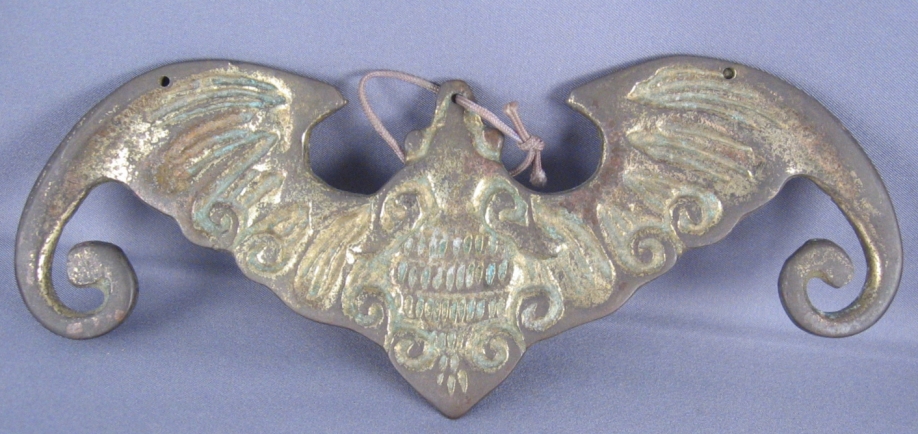
In Chinese culture, bats have a positive symbolism, and are considered to bring good luck, because the Chinese word for bat (fu,蝠) resembles the one for luck (fu,福) and is also written similarly. Here are a couple of  good-luck bats that are meant to be hung in the home, one in wood, and the other in gilt bronze. (Neither of these is very old; in future posts, I plan to examine how bats were incorporated into antique and vintage items.)


Bats are very auspicious commercially, as in this sign for “One Luck” take-out food.


If these outlines of Chinese bats are starting to look familiar, that is because bat-shaped hardware was borrowed by the heavily Chinese-influenced furniture designer Thomas Chippendale. Once you see this connection, a lot of Chinese-inspired scroll-work will resolve itself into bat-forms. Here are a couple of bonnet-top high chests from the Boston Museum of Fine Arts which incorporate Chinese Chippendale drawer-pulls and other brasses.

An Eighteenth-century Massachusetts high chest.

Detail of Massachusetts chest.


Another high chest, this one by famed Newport cabinetmaker John Townsend, c.1750’s.

Detail of Townsend chest.


Bats are truly ubiquitous here in Taiwan. They are found in good-luck charms, jewelry, home furnishings, stationery—just about anywhere. Taking a look around my apartment, I noticed a bat motif in the tile floor of the balcony, which has a repeating design of four bats facing inward in a circle:


The corners of my coffee table are enhanced with carved bats.


Here is an especially festive and friendly bat that adds an additional good-luck element to a New Year’s decorative firecracker.


So now that you have compared both types, which bats do you prefer:  auspicious, friendly, attractive Chinese ones, or dreadful, unlucky, ominous Western ones?

One more look at a scary Western bat.

=====================================================================
Photo credits: The two high chests are courtesy of the Boston Museum of Fine Arts, www.mfa.org. All other images belong to the author.

Saturday, October 8, 2011

Zhu Bajie: The Pig God (Nice ladies please DO NOT read this)


A fascinating aspect of Asian culture is the vast number of religious statues. Many of these are deities, although others are demons, generals, teachers, ancestors, and even animals. Some statues such as Guan Yin are peaceful and beautiful, but there is an amazing variety.

One of the more interesting ones I’ve come across is Zhu Bajie, a character from the Ming dynasty novel, Journey to the West, also known as Monkey. Zhu Bajie, represented as a human body with the head of a pig, was a heavenly commander who was cast down to earth because of his piggish appetites, and who then had many complicated adventures.


My first indication that this was an unusual object was when I bought it, and I was warned not to give the effigy to any female friend or relative, because this character was rather unsavory, and was the special “guardian saint” for prostitutes. Keith Stevens in the Journal of the Royal Asiatic Society Hong Kong Branch had this to say about Zhu Bajie:

"Although he is usually regarded China-wide as the epitome of gluttony, in Taiwan he is also revered by prostitutes who call on his divine title Shoushou Ye, offering him incense and chants morning and evening whilst calling on him to bring them rich guests, foolish and witless, to be fleeced." 

Quite a reputation this Zhu Bajie has. Since I brought him into my apartment I have not noticed any material change in the quality of my guests and other visitors (although naturally I would be too polite to tell the truth on that score. Furthermore, maybe I didn't get the chant right.)


I have managed to find a couple of other images of Zhu Bajie. The above panel came from a piece of furniture, and is a mahogany-like wood, inlaid with boxwood and bone. Unlike the happy 3-D statue, this one looks disgruntled, and the bird next to him doesn’t look too happy, either. Also, he is holding a large flower, whereas Zu Bajie’s normal attribute is a rake which he holds as a weapon. He may look like he is waving, but actually he is about to wreak destruction.

Zhu Bajie with Rake. (Source:  http://tech2.npm.gov.tw/literature/beauty/beauty.asp?B=137.jpg)


This rather trim and stylish example is very similar to the top one, though perhaps a bit more brightly colored. While both of these small statues have lost their rakes, their right hands are eternally raised to wield them.

Normally, statues like the above are placed on home altars or in temples, so I had assumed that Zhu Bajie dates back into Chinese mythology, but apparently he originated in the Journey to the West novel, many scenes from which have made their way into Chinese art. I find these little statues appealing and a little bizarre, but strangest of all is how a fictional character was deified by prostitutes.