Showing posts with label Bats. Show all posts

Wednesday, April 16, 2014

Chinese Antique Thread Winders with Bats


Detail of carved bat.
 
Congratulations to Rosemary and to Mariette for correctly identifying the Mystery Object as a thread winder or spool. These wooden winders are two to four inches long, while smaller ones, beautifully worked from mother of pearl, often resemble game counters. Winders are often adorned with flowers, butterflies, fish, or geometric shapes, although readers here can readily imagine that I was pleased to find the bat motif.

 
This winder has a pattern of two bats on each end, facing a peach, the symbol of longevity. As the Hattatts reminded us, bats are a Chinese symbol of good fortune, so although I know of no special connection to thread or sewing, it is not surprising to see this figure turn up. 

The reverse of the winder shows a repeat of the same pattern.
 
I was lucky enough to acquire an additional example of these bat-carved thread winders. This other one is somewhat different. The spool section is deeper, and the carving is open or pierced. There are only two bats on each side, facing the center, and their auspicious symbolism is augmented by that of the coin placed in the middle.

 
As before, the carving on the back duplicates that on the front. Note that the coin has changed into a longevity symbol.


It is difficult to decide which one I like better—the second example is quite graceful with its openwork filigree, but the solid first one, with eight bats in total, has to have one of the highest bats-per-square-inch ratios for an object its size. They both show signs of considerable use, and the gilding on each is almost gone. They must have been quite dazzling when new, although possibly I prefer their current worn and patinated condition.

Reader Dianne in the original post mentioned Bat Conservation International, and I had a fascinating time perusing their site. I strongly recommend taking a look at their website to learn more about actual bats and about the various problems, natural and human, that currently threaten them.


(All photos and original objects property of the author.)

Thursday, October 31, 2013

Taipei’s Halloween Earthquake

Tonight, October 31, 2013 at about 8:00 p.m., there was a sizable earthquake in Taipei. I was working at my desk when I felt the first tremors. It quickly got worse; the bookshelves were swaying hard, and I thought they might fall over, but a minute later it was over. 


Taiwan is in the earthquake zone, and small temblors occur often, but this one was pretty strong—6.7 magnitude. Still, as far as I've heard, there was little real damage. The last really tragic earthquake in Taiwan hit central Taiwan in 1999, before I arrived here.

Broken netsukes—the brown ironwood one was holding a double gourd, and the lighter boxwood one was bent down and holding his tibia. 
 
Nevertheless, when I looked over my living room, I discovered a few casualties. I had put out some skeleton netsukes for Halloween, but the spirits-at-large must not have liked the irreverence of this display, for several of them had fallen and smashed. 


The strangest part is that although I looked and even swept carefully, I was not able to recover all the fragments. I can only assume that the malevolent spirit that swept through Taipei and through my apartment had come to retrieve them, like Madame Zena in A Drop of Water (from the movie Black Sabbath) reclaiming her stolen ring.

Netsukes, small Japanese carvings of wood or ivory, are found in an infinite number of designs, often depicting people, children, gods and animals, but scary themes such as skeletons, rats or insects, are also common.


I was amused to notice that this toy balancing bat, resting on its pinpoint on a narrow strip of wood, managed to maintain its perch through all the shaking. The god on which he has alighted, called the Fighting Money God, may have lent his protection, as bats often symbolize money or wealth in Chinese art.


All of you who can place delicate objects on high shelves, count yourself lucky, because here such freedom is not a given. I was fortunate that nothing happened to these lacquered wooden boxes, which I had riskily lined up on top of bookcases:

I just realized that all the books on this shelf are by P.G. Wodehouse--there goes my reputation for serious scholarship.


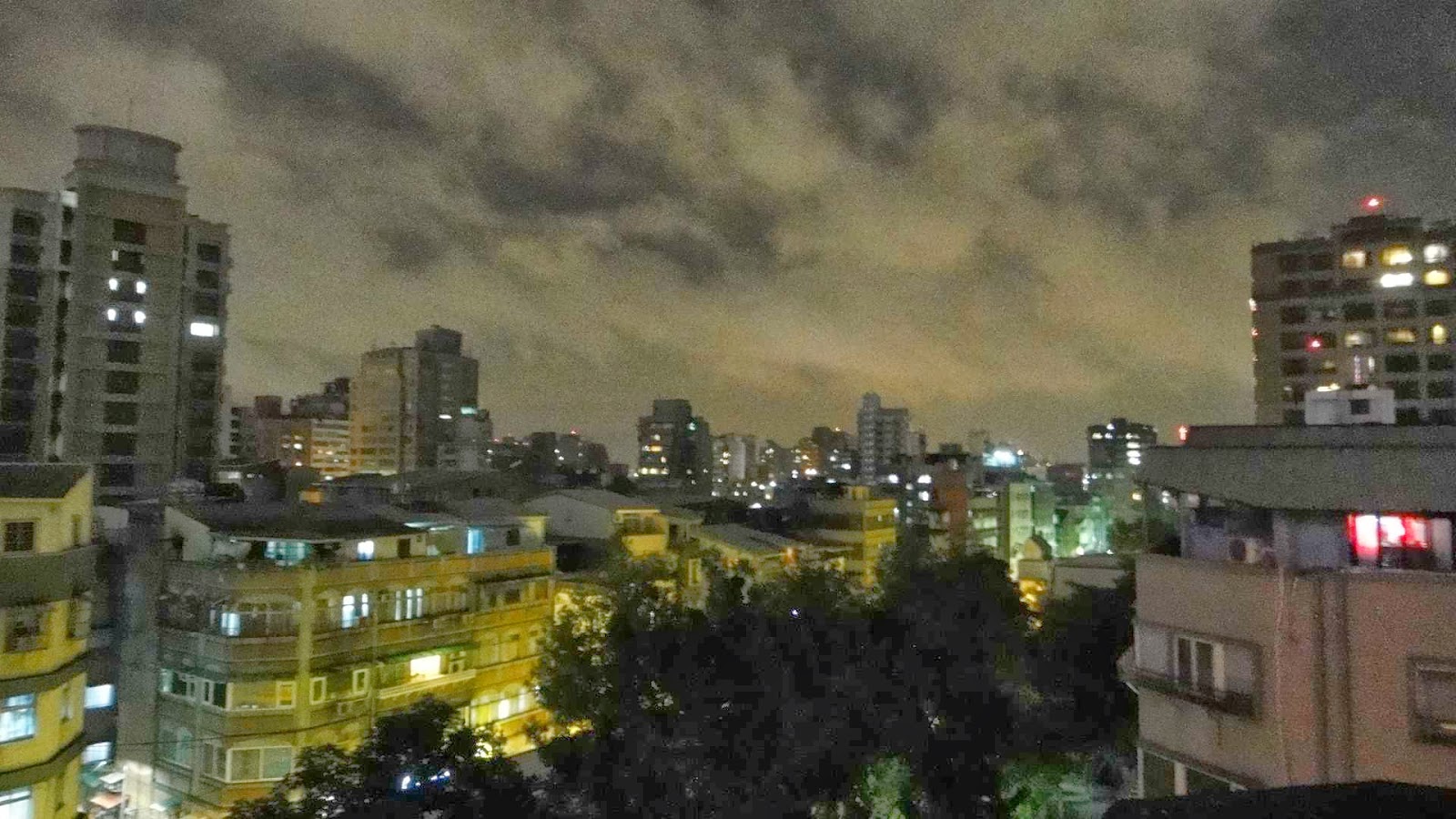
Often around Halloween there is a weird glow at night which adds to the spooky atmosphere. The view tonight from my balcony is a perfect example, reminiscent of the nighttime postcards I wrote about last year.

Have a Happy and Safe Halloween!


Who knows what strange spirits roam Taiwan on Halloween?

(All photos by the author.)

Thursday, October 27, 2011

Bats: Terror of the Night, or Omen of Good Luck?


With its gauzy blue wings and glittery details, the above Chinese bat is perhaps the most delicate and pretty one that I have seen. Since Halloween is coming up, with its frightening images of attacking vampire bats, I thought this would be a good time to compare Eastern and Western bats.

"I want to suck your blood...."

This bat, with its matted fur, sharp fangs, and glowing red eyes, shows the Halloween bat at its fearsome worst. However, even Western scientific treatises manage to capture the most menacing and unfriendly aspect of bats, as in this hand-colored engraving from a natural history text of 1840:


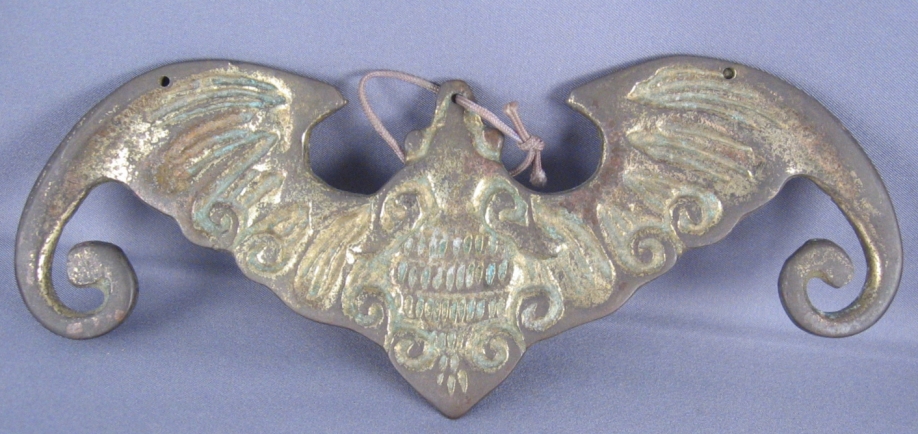
In Chinese culture, bats have a positive symbolism, and are considered to bring good luck, because the Chinese word for bat (fu,蝠) resembles the one for luck (fu,福) and is also written similarly. Here are a couple of  good-luck bats that are meant to be hung in the home, one in wood, and the other in gilt bronze. (Neither of these is very old; in future posts, I plan to examine how bats were incorporated into antique and vintage items.)


Bats are very auspicious commercially, as in this sign for “One Luck” take-out food.


If these outlines of Chinese bats are starting to look familiar, that is because bat-shaped hardware was borrowed by the heavily Chinese-influenced furniture designer Thomas Chippendale. Once you see this connection, a lot of Chinese-inspired scroll-work will resolve itself into bat-forms. Here are a couple of bonnet-top high chests from the Boston Museum of Fine Arts which incorporate Chinese Chippendale drawer-pulls and other brasses.

An Eighteenth-century Massachusetts high chest.

Detail of Massachusetts chest.


Another high chest, this one by famed Newport cabinetmaker John Townsend, c.1750’s.

Detail of Townsend chest.


Bats are truly ubiquitous here in Taiwan. They are found in good-luck charms, jewelry, home furnishings, stationery—just about anywhere. Taking a look around my apartment, I noticed a bat motif in the tile floor of the balcony, which has a repeating design of four bats facing inward in a circle:


The corners of my coffee table are enhanced with carved bats.


Here is an especially festive and friendly bat that adds an additional good-luck element to a New Year’s decorative firecracker.


So now that you have compared both types, which bats do you prefer:  auspicious, friendly, attractive Chinese ones, or dreadful, unlucky, ominous Western ones?

One more look at a scary Western bat.

=====================================================================
Photo credits: The two high chests are courtesy of the Boston Museum of Fine Arts, www.mfa.org. All other images belong to the author.