Friday, July 27, 2012

Stan Hywet Hall in Akron, Ohio


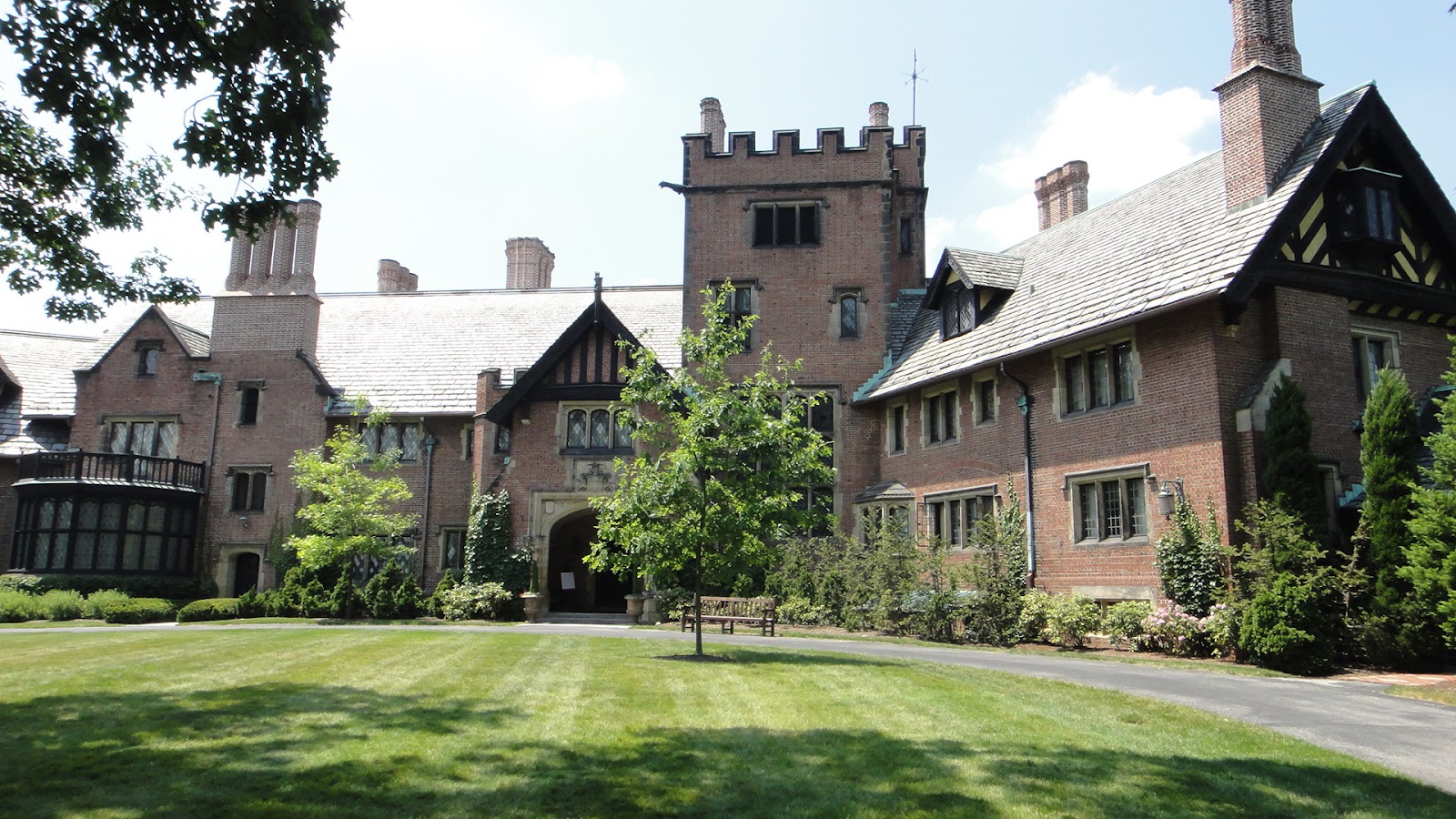
Stan Hywet Hall, main entrance

One highlight of my trip to Cleveland was the day spent at Stan Hywet, the former home of Goodyear Tire and Rubber Company founder Frank A. Seiberling. Stan Hywet is a rather large house at 64,000+ square feet, but its rambling design and close integration with its gardens is intended more to charm than to overwhelm. 


Aerial view of the house, towards the back.
 
Stan Hywet,  pronounced ‘stan hee-wit’ and meaning ‘stone quarry, was built from 1912-15 by architect Charles Sumner Schneider.  The quality of every detail was first rate, including interiors by H.F. Huber and Co., and ironwork by the famous Samuel Yellin.

Detail of copper downspout


This side porch was beautifully designed and carved.
 
I love old houses, and Stan Hywet is especially enjoyable to visit. There is so much to see, and so much that is beautiful and impressive. In addition to the house and grounds themselves, our visit was enhanced by the helpful docents and other staff, all of whom seem to love the house and want to share their enthusiasm with you.

One special feature of Stan Hywet is that it never went through a lot of owners and remodelings. The Seiberlings donated the house as a non-profit museum in 1957, and as a result the house is in remarkably original condition—the furniture, paintings, dishes, even the pots in the kitchen are all still there.

The most comfortable and inviting room in the house has to be the music room. In addition to an English harpsichord, it boasts a pipe organ, now playable by remote control, providing quite a start when the docent activates the mechanism . During our visit, a display of antique jewelry, some of it belonging to the Seiberlings, was set up in this room.


The Music Room

 
Stan Hywet was designed in the Tudor Revival style, and so naturally includes a Grand Hall. This photo, taken from the balcony, doesn’t accurately give a true impression of the size and grandeur of this room.

The Great Hall
 
The Seiberlings’ Goodyear Tire and Rubber Company was named after Charles Goodyear, inventor of the vulcanization process for rubber. It is appropriate then that this very Victorian console table on the landing of the Tower stairs was actually made of vulcanized rubber.


There is a large, formal dining room, but everyone was taken with the charm of the more intimate breakfast room. The lower ceiling, beautiful woodwork and display of blue and white china seemed quite cozy, while the large expanse of leaded glass led to a view of the lawn and gardens beyond. An impressive feature was the separate breakfast kitchen immediately adjacent, to ensure that the Seiberlings’ eggs and toast arrived piping hot.

 
Stan Hywet is outstanding for its extensive gardens. These are fascinating to stroll around, and also provide magical views from every window of the house. The main gardens were designed by Warren H. Manning at the time the house was built, and the current English Garden is the 1929 creation of Ellen Biddle Shipman. It is rare to find works by these two landscape designers both well-maintained and open to the public.

The Birch Alley


The English Garden

Pool in English Garden

Glimpse of house from rear garden
 
This article doesn't even begin to cover the many features of this estate. We were unable to visit the Lodge or the Greenhouse that day, but it is impossible to miss the old stables and carriage house, which now serves as the entrance gate, gift shop and refreshment area. You need to sit down and relax a bit after exploring Stan Hywet, and this is even more enjoyable when the tables are set up in the original stalls. Even the stables were designed with the attractiveness, spaciousness and perfection of every detail that was life at Stan Hywet. 

This stable was never meant to be hidden from view.


Refreshments served in the original stalls.

Stan Hywet was always intended to make people comfortable, first the Seiberlings and their guests in the early 1900’s, and now the public. The motto that adorns the house, Non Nobis Solum  (Not For Us Alone) seems to have been taken to heart, and infuses the spirit of hospitality that is still there to greet you.

A covered porch/walkway overlooking the gardens.

All interior photos, plus the aerial view, courtesy Stan Hywet Hall. All other photos taken by the author.

Wednesday, July 18, 2012

Traveling Back in Time to Chagrin Falls, Ohio

 
A summer tradition in Cleveland is taking a ride and strolling around the historic village of Chagrin Falls, located on the curiously-named Chagrin River. One story is that early settlers were aiming for the Cuyahoga, the next big river over, and were ‘chagrined’ when they discovered their error;  more likely, the name derives from an Indian word.

The Lower Falls


The principal feature of the town is the falls, which once provided power for mills and other industry.  Main Street divides the Upper and Lower Falls, and once provided with ice cream, you can walk in Chagrin Falls Park on the one side, or cross the street and descend stone steps to the Lower Falls.


 Upper Falls and pool alongside the park.


Main Street is lined with old Victorian commercial buildings, which now host an array of clothing, book and antique shops, as well as restaurants.


Perhaps carrying the high-toned theme a bit too far...

Don't speed, or you might catch sight of this in your rear-view mirror.
 
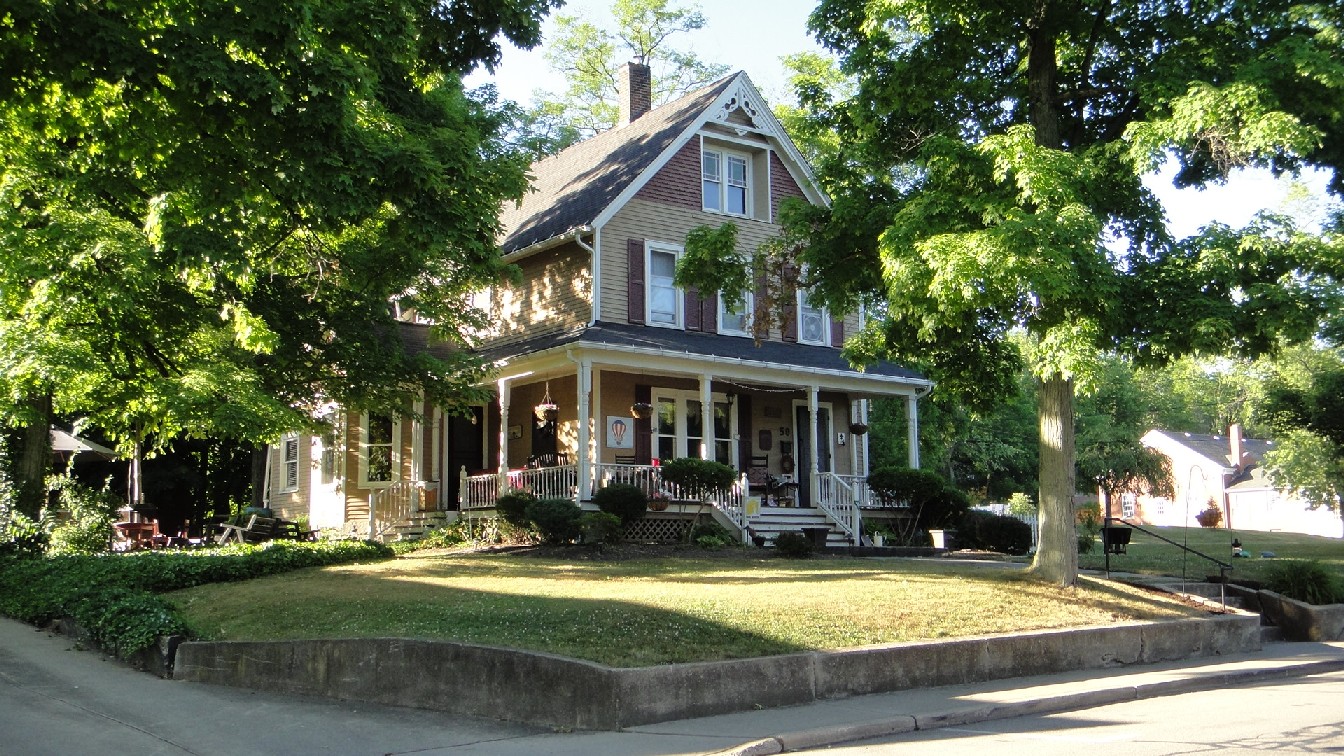
My favorite part of Chagrin Falls is its large collection of 19th-Century houses. The ones depicted here are mostly Victorian—these are perhaps outnumbered by Greek Revival and other early wooden clapboard houses, but I didn’t seem to be in the right part of town that day.


Although CF is famous for earlier architecture, these beautiful Italianates also abound.


The Police Department is located in this beautifully-restored brick house.


An old hitching post and flagstone walk are reminders of earlier times.


A mallard duck adds an appropriate accent to this preppy enclave.

Wednesday, July 4, 2012

Red, White and Blue

All set for the Fourth!

Happy Fourth of July, everyone. I apologize for disappearing for such an unseemly length of time--I have been traveling with limited internet access. The house in the above antique photograph was all decked out with patriotic flags and bunting for the holiday, but unfortunately it was in black and white. Sometimes these were hand colored for a more festive look, and I decided to see if I could emulate this with a quickie photo editing program. My efforts were quite crude, but that sometimes is the charm of hand-colored photographs.


Here is the original photo:


First, I colored in the bunting, then added green shutters while incidentally fixing the roof:


The hydrant and telegraph pole were distracting, so they had to go, even though the kids in the photo might resent having their source of water removed on a hot July day.


Finally, a quick wash over the trees and lawn, and some garish pastels for the clothes completed the effect. I blush when I think how much better this could have been done by one of the talented bloggers out there, such as Mark Ruffner, but the project was fun, manipulating old photos is addictive, and now I am ready to celebrate America's Independence.

Monday, May 21, 2012

Fantasies in Glass Beads: Chinese Embroidered Headbands

I confess that I have no manual skills, and that all handcrafts, including painting, sculpture, and needlework, are mysteries to me, bordering on black magic. These skills are evident to a remarkable degree in Chinese headbands, sometimes called mei-lei (眉勒). Worn on top of the forehead to keep back the hair, mei-lei were often very colorful and well-decorated, sometimes embroidered with tiny glass beads. Although these are not my usual type of collectible, I couldn’t resist their intricate, colorful designs.


The way the beads are made into pictures is reminiscent of micro-mosaic work, the kind that was a staple for souvenirs from 19th-Century Grand Tours of Greece and Italy. The beading as a rule is considerably more stylized, without fine shading effects.

Micromosaic brooch  of the Pantheon, c.1875  
=============================================================

Here is the entire piece from the first close-up. This brightly-colored headband is very well designed and executed. The black background in the flowered border seems to give it an exotic quality, and the blue of the center section is strong enough not to seem washed-out by contrast. While the flowers in the border are stylized, those in the center panel are portrayed as growing naturally and luxuriously, and the red-headed birds add a charming touch. Unfortunately, in the very center there should have been a jewel which is now missing, but the two mother-of-pearl buttons at either end for securing the headband are still present.

=============================================================


This second mei-lei has opposite tonalities, with a white border and a dark center. Like the preceding one, the outer flowers are stylized while the inner ones meander, attached to their stems. There are remnants of the black strings which once tied it into the rest of the headdress. Luckily, this example still retains it center glass jewel, a large ‘emerald’ surrounded by ‘rubies’ and ‘diamonds’. I apologize that the jewel was not photographed very well; however, the picture demonstrated how these headbands are not flat, but have a hump in the middle to enhance the shape when worn, and to help display the jewel.


====================================================


This final example is more delicately colored, with a gray-green center surrounded by a white border. The border incorporates the Chinese character called double-happiness (囍), indicating that this was probably made for a wedding, or as a wedding present. Another charming detail in the border is that for each pair of birds, one is offering a flower to the other, who is accepting it. Just don’t ask me which are male or female!

In the central part, there is a design of flowers with a bat hovering above. (Remember that in Chinese culture, bats symbolize good luck.) An oddity here is that the two halves are not symmetrical, and furthermore seem to have been executed by two different hands. The sizes and shapes of the bats are different. Also, on the right side, the bat is flying over vaguely heart-shaped flowers or fruits, but on the left side, the fruits look distinctly like pomegranates.

In addition to two white glass buttons for attachment, this one still retains its center glass jewel, a large white ‘diamond’, surrounded by ‘rubies’ and ‘emeralds’.


Parthenon brooch photo from Wikipedia, all others belong to author.

Monday, April 2, 2012

A Chinese Ru Brush-washer at Sotheby’s

Check behind the sofa cushions for spare change, because you’ll need it all to raise your bid on one of the most remarkable ceramic objects ever to come up for sale. On April 4, 2012, Sotheby’s in Hong Kong  (sale HK0367) is offering a Ru-ware brush washer in its sale entitled Ru From a Japanese Collection.

Ru (also called Ju) is the zenith of Chinese ceramic art. Made in the Northern Song dynasty in the Twelfth century, very little Ru was made to begin with, and most of the surviving pieces (fewer then 100) are in museums. So this opportunity to obtain the brush washer is really a red-letter day. The piece is so important that the entire auction consists of just this single bowl.
I have been planning to write about Ru ware for a while, but I want to revisit the Palace Museum again first, which boasts the world’s finest collection of these pieces. What makes Ru so special? First is the remarkable potting of the shapes. In the present brush washer, notice the overall perfection of form, the thinness of the body, and the elegance with which the lobes or points are formed.
The main glory of Ru ware, however, is the magnificent glaze, normally a robin’s-egg blue, with a distinctive pattern of crazing. It is difficult to photograph the beauty of the glaze, because the way the light both penetrates and is reflected back is quite dynamic. The play of color and light needs to be witnessed in person.
Close-up of the glaze and craquelure pattern.

Because the ware was so fine, the potters needed a way of supporting it in the kiln which would not damage the glaze, so the pieces rested on small spurs which left characteristic “sesame seed” marks on the bottoms of the pieces.
The back of the bowl, showing the famous sesame-seed kiln marks.

The condition report acknowledges a small amount of rim damage, which is visible in the overhead shot. Sotheby’s estimate for this lot is sixty to eighty million Hong Kong dollars, roughly eight to ten million U.S. dollars. This is a true museum piece, and one of the few times a piece of this beauty, rarity and importance is offered for sale.
                                             ===========================
Update! The auction has ended, and this bowl including buyer's premium sold for HK$208 million, or US$27 million. I am sure that this will start droves of discussions on the state of the market, and where the money is coming from, etc., but the fact remains that pieces this rare and extraordinary will always command a lot of attention and create record-breaking prices.

All photos from www.sothebys.com