Last summer I was sorting
through a box of brass instrument mouthpieces, placing them on a table as I
unpacked them. My mother happening to come by asked me, “How many mouthpieces
do you need, anyway?”
Of course, there is no limit
to the number of mouthpieces I need, but what struck me about her question was
that although they may appear similar, there are worlds of differences between mouthpieces
that make ownership of many of them not an idle whim, but a vital necessity.
 |
| Unpacking these brass mouthpieces was like
visiting old friends. |
I like to play old brass
instruments, especially the cornet and the alto horn, and each mouthpiece has
its own qualities and merits. The difference they can make in the playability
and sound of each instrument is almost unbelievable. This is in addition to
their different appearances and historical associations.
The mouthpieces they make
today can be very high quality, but may be very inappropriate to use with old
instruments. This is especially true for cornet mouthpieces, which used to be
conical in shape, and gave a more mellow sound. Today’s cornet mouthpieces are
more like miniature trumpet mouthpieces, featuring a cup-shaped interior, and give
even antique cornets a more brilliant, trumpet-like sound, which is at odds
with old cornet music, which, while capable of brilliance, revels in its moonbeams-and-roses,
Victorian atmosphere.
The late 19th and
early 20th century were the golden era of brass instruments, when
every town had its own brass band, and cornet and trombone soloists such as
Jules Levy, Herbert L. Clarke, and Arthur Pryor were all household names. Many
old mouthpieces feature the names of premium manufacturers, and were modeled
after the preferences of the famous brass soloists of years gone by.
When you obtain an old brass
instrument, you should gather as many historical mouthpieces as possible, and see
which ones fit the instrument, your anatomy (embouchure), and personal playing
style. Here are a few particular ones from my collection:
 |
| This tuba mouthpiece is very special to me, as
it belonged to my grandfather, a professional tuba player and music store owner
in Canton, Ohio. It was custom made to his specifications by the famous maker
Vincent Bach, and has my grandfather’s initials, E.G. for Edward Gottlieb,
stamped on it. |
 |
| Here are two very early ivory mouthpieces made
for bass instruments such as serpents and ophicleides. |
 |
| An example in the V&A of a serpent, an early
bass instrument and predecessor of the ophicleide and tuba, and often played
with ivory mouthpieces like the above. |
 |
| Three trombone mouthpieces from different eras.
At left is a modern Vincent Bach, in the middle an anonymous Victorian example,
and on the right an early 20th century Lyon and Healy, a fine maker,
with its more sleek “moderne” shape. |
 |
| Two trombone mouthpieces endorsed by famous
players. At left is a Conn Pryor model. Arthur Pryor was possibly the greatest trombone
player in history. On the right is an Innes model, also by Conn, named for
Frederick Neil Innes. |
 |
| Arthur Pryor was a trombone player whose virtuosity was stunning, and whose playing was often captured on early records. He also wrote many brilliant trombone solos still played today. |
 |
| Frederick Neil Innes was another trombone
soloist of the golden era, who likewise wrote solo compositions still popular
with all brass players. |
 |
| Here are two alto-range mouthpieces. First, a
mellophone mouthpiece by Conn—all brass instruments and mouthpieces by Conn are
first-rate. Next to it is a cheap, modern alto mouthpiece by Herco (even the
name sounds unpleasant!). There really should be a law forbidding Conn and
Herco to be photographed together. Herco is a terrible mouthpiece,
uncomfortable to play and inferior-sounding. These are often given to new students,
who understandably give up after a short while, thinking that the fault is
theirs. There really is no excuse for poor quality mouthpieces like Herco or Jupiter when so
many fine ones are being made—or just lying around. They deserve C.S. Lewis’s
description as mouthpieces “that the lip loves not.” |
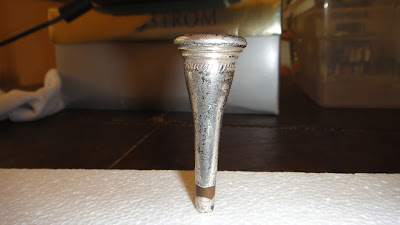 |
| A modern but fine quality French horn mouthpiece
by Rudy Muck, which I found at a house sale just last summer. |
 |
| Three early trumpet mouthpieces, by Hill,
anonymous, and Cousenon, the latter a fine French maker. |
 |
| More modern trumpet mouthpieces by Holton
(always a great name), Vincent Bach (again), and H.N. White, a maker of
professional quality instruments in Cleveland, Ohio. |
 |
| Finally, we get to the all-important category of
cornet and bugle mouthpieces. Here are two very early examples. |
 |
| Classic early cornet mouthpieces by Pepper,
Besson (another important French maker), McMillin (another quality Cleveland
maker), and Charles Triebert. Charles was the brother of Frederic Triebert, the
maker most important in developing the modern oboe (my main instrument). The
Charles Triebert company continued into the 20th century, and
appears to be a mass maker of many types of band instruments. |
 |
| A variety of good cornet mouthpieces. First, a
modern Vincent Bach (naturally!), followed
by a fine and classic Frank Holton. Next is a H.N. White cornet mouthpiece
(White was McMillin’s foreman, and apparently took over his operations.)
Finally, a Conn Wonder, an instrument and mouthpiece that seems to find special
favor with musicians. |
 |
| A top view shows the differences between old and
newer cornet mouthpieces. Notice the shallow, cup-like depression in the Bach
mouthpiece on the left, in addition to its general massiveness, compared to the
deep, conical interior of the older and lighter Holton model on the right. The
shape of the interior is probably the single-most important factor in the basic
sound of the instrument. |
 |
| A spectacular find, “The only genuine Levy
Model” made by Lyon and Healy. Jules Levy was the greatest cornetist of the
late 19th century. |
 |
Jules Levy was habitually known
as “The World’s Greatest Cornetist.” Although he did make a few fine records in
the early 1900’s, he was by then a little past his prime, but these records are
still treasured. In addition to his brilliant playing, he was known for his
beautiful phrasing, and famous opera singers would attend his concerts to hear
him play and learn phrasing from him.
|
 |
Along with the mouthpieces
themselves, one has to look out for the small tuning bits or shanks, which
could correct the pitch of an instrument in an era of multiple pitch standards,
or even make it play in another key, while acting as a liaison between
mouthpiece and instrument.
|
 |
A special tribute to my very
favorite: an anonymous 19th century alto horn mouthpiece. It might
not look like much, but it plays great, and is very comfortable. I brought this
to Taiwan to play with an old Conn alto horn from the 1920’s, but unfortunately
brass instruments are too penetrating to play in an apartment (I don’t hate my
neighbors that much!).
|
 |
| At this point, the different silhouettes of the
mouthpieces will convey more meaning, as well as show the size range for the
several types of instruments. This just represents one box worth, and is hardly
a treatise on mouthpieces, but I hope that some of their basic differences and
qualities have been illustrated. |
How does one acquire so many
examples? When I was in college, I used to stop in at older-looking music
stores and ask if they had any old mouthpieces lying around. They usually came
up with a box of miscellaneous parts and junk from the back room from which I
could choose; some real treasures turned up this way.
If you play a wind or brass
instrument, did you have a special mouthpiece that made all the difference when
playing it? What about brass instruments in general—do you have a particular favorite?
Although I most often play the alto horn, my real favorite is the old-fashioned
cornet, especially when played by the likes of Jules Levy, Herbert Clarke, or
Bohumir Kryl on early records.
You are supposed to blow
horns to usher in the New Year. I hope that this post will get everyone in the
mood, and that all my readers have a happy, healthy and prosperous 2018!
All mouthpieces and photos of same property of the
author.
Photos of Pryor, Levy and the Serpent via Wikipedia.
Photo of Innes located here.


